
Travel guide
Japanese Covered Bridge in Hoi An: History, Architecture and a Local Perspective

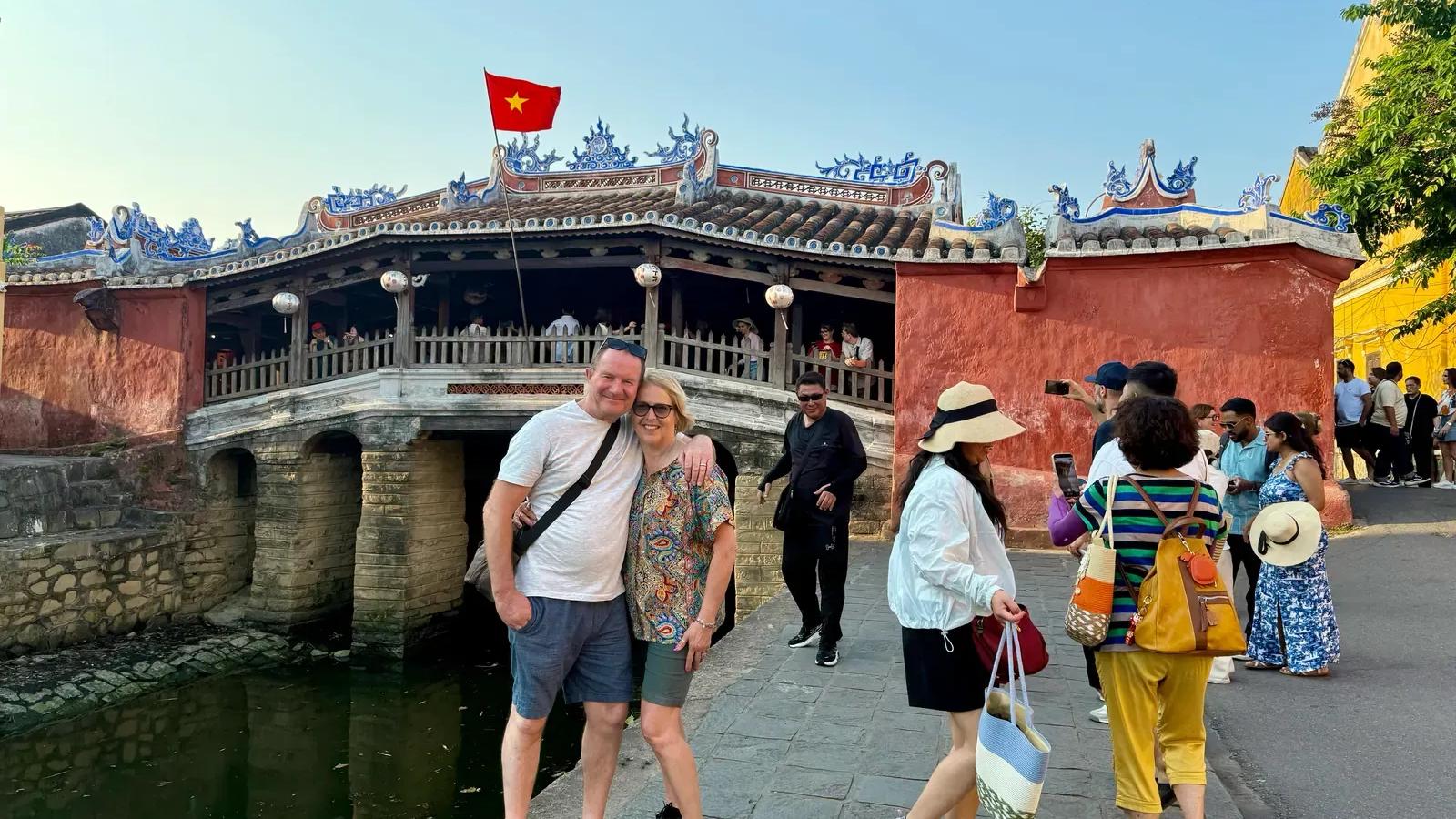
More Than a Famous Landmark
For many travelers, the Japanese Covered Bridge is one of the first images associated with Hoi An.
For me, it is much more personal.
I grew up in Hoi An, and one of my favorite memories is coming to the area around the bridge early in the morning, sometimes around 7:00 AM, enjoying a coffee while the streets were still quiet.
At that hour, Hoi An feels very different from the busy town many visitors experience later in the day.
There are fewer people, the light is softer, and the bridge feels less like a tourist attraction and more like part of the old town I remember growing up with.
That peaceful feeling is one of the reasons I still enjoy bringing visitors here early in the morning.
Why Is It Called the Japanese Covered Bridge?
The bridge is commonly known as Chùa Cầu, the Japanese Covered Bridge, or Lai Viễn Kiều.
Historical sources from Hoi An describe the bridge as having been funded and built by Japanese merchants around the 17th century, when Hoi An was an important international trading port.
A small temple section was later added to the northern side of the bridge. Local historical material records that this addition dates to 1653, which is one reason the structure became known locally as Chùa Cầu, literally the “pagoda bridge.”
In 1719, Lord Nguyễn Phúc Chu visited Hoi An and gave the bridge the name Lai Viễn Kiều, usually understood as a bridge welcoming visitors from afar.
For me, that name is particularly meaningful.
Hoi An has always been a place shaped by people arriving from different places, exchanging goods, ideas, beliefs and traditions.
The bridge is therefore not only a physical crossing. It is also a reminder of the cultural connections that helped shape Hoi An.
Look Up at the Roof
One of the first things I often ask my guests to notice is the roof.
The bridge is covered with traditional tiles, and when I guide visitors here, I often use the roof to introduce the idea of yin and yang in traditional architecture.
Instead of simply walking across the bridge, I encourage people to slow down and look at small details.
The roofline, timber structure, carvings and covered passage tell us that this was never designed as just a simple crossing.
UNESCO describes the Japanese Bridge as one of the distinctive wooden structures within the historic townscape of Hoi An.
That is something I have learned repeatedly as a guide: sometimes the most interesting story is above your head, beneath your feet or hidden inside a detail most people walk past.
A Bridge Between Cultures
Hoi An's history was shaped by international trade.
Japanese merchants were active here during the 16th and 17th centuries, while Chinese communities later became increasingly important to the town's commercial and cultural life. UNESCO material also notes the historical presence of Japanese merchants and the development of a Japanese quarter in Hoi An.
The bridge therefore gives us a useful starting point for understanding Hoi An's cultural mixture.
Rather than describing Hoi An as simply “Vietnamese, Chinese and Japanese architecture mixed together,” I prefer to explain how different communities lived, traded and interacted here over time.
That human story makes the architecture easier to understand.
The Temple Is Not Dedicated to Buddha
Another detail visitors often find surprising is that the temple attached to the bridge is not primarily a Buddhist shrine.
Local heritage documentation states that the shrine traditionally honors Bắc Đế Trấn Võ, a protective deity associated with wishes for peace, protection and well-being.
This is a good example of why I encourage visitors not to judge a building only by its English name.
“Japanese Covered Bridge” explains part of its history.
“Chùa Cầu” tells another part.
“Lai Viễn Kiều” gives us another layer again.
Each name opens a different door into Hoi An's story.
The Legend Beneath the Bridge
There is also a well-known legend connected to a giant mythical creature, often associated in local storytelling with earthquakes and natural disasters.
According to the legend, the bridge was symbolically placed over the creature to control it and bring greater peace and stability to the surrounding communities. Hoi An's official heritage material records this story as part of the traditional interpretation of the bridge.
When I share this with visitors, I always explain that this is a legend, not an engineering explanation of why the bridge was built.
That distinction matters.
History and folklore can live side by side, but they should not be presented as the same thing.
A Landmark That Is Still Being Preserved
The Japanese Covered Bridge has required repeated conservation because it is an old timber structure exposed to weather, humidity, flooding and constant use.
A major restoration project began in late 2022 and, after almost 19 months of work, the restored bridge was officially inaugurated on August 3, 2024. The conservation involved Vietnamese specialists with consultation and cooperation involving Japanese expertise.
For me, restoration is part of the story of Hoi An.
Heritage does not survive simply because a building is old.
It survives because communities, specialists and future generations decide that it is worth protecting.
A Small Detail on the 20,000 VND Note
One detail I enjoy showing visitors is something they may already be carrying in their pocket.
The Japanese Covered Bridge appears on Vietnam's 20,000 VND banknote.
It is a simple way to show how strongly the bridge has become associated with Hoi An and Vietnamese cultural heritage.
Sometimes I ask guests to compare the banknote with the bridge standing in front of them.
It usually creates a small moment of surprise—and those are often the moments people remember.
What I Want Visitors to Notice
When I bring someone to the Japanese Covered Bridge, I do not want the experience to be only:
“Take a photo and continue walking.”
I want visitors to notice the roof.
Look at the wood.
Think about the waterway beneath it.
Understand why Japanese merchants were here.
Ask why a shrine was built onto a bridge.
Think about why the structure has survived for centuries—and why people are still investing so much effort in preserving it today.
Most importantly, I want visitors to understand that the bridge is connected to a much larger story.
It is connected to trade.
To migration.
To religion.
To architecture.
To cultural exchange.
And to generations of people who have lived in Hoi An.
My Favorite Time to See the Bridge
Personally, I still prefer the early morning.
Around 7:00 AM, before the streets become busy, the area has a different rhythm.
Sometimes I simply enjoy a coffee nearby and watch the town wake up.
For me, that quiet atmosphere brings back something of the Hoi An I remember from growing up here.
I cannot promise every visitor will feel exactly what I feel.
But I can share the bridge as I have experienced it—not only as a landmark, but as part of my hometown.
And that is the kind of experience I want to create when I guide people through Hoi An.