
Travel guide
The Carp Dragon Statue and the Story of Transformation

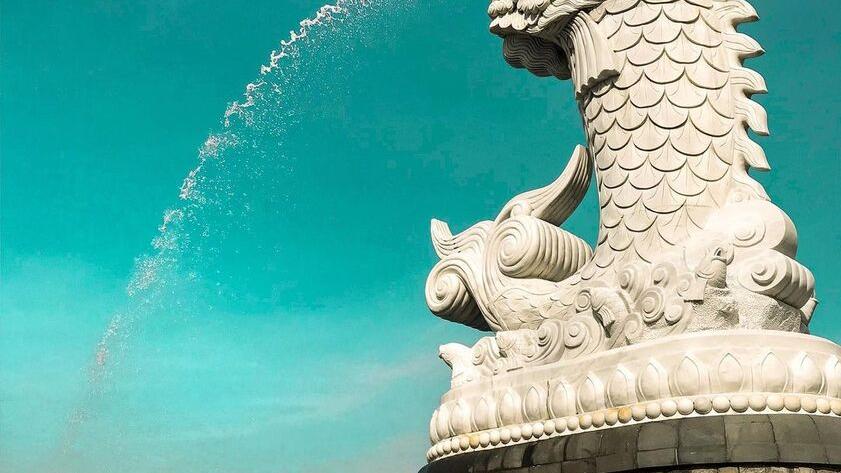
The Carp Dragon Statue in Da Nang invites a question before it invites a photograph: why does a fish take the form of a dragon? That question leads to a familiar East Asian story of effort and transformation, and gives a small riverside stop a clear cultural subject.
Known in Vietnamese as Ca Chep Hoa Rong, the statue stands near the Love Bridge beside the Han River. It is a modern landmark using an older symbolic language. Its meaning can be explored without confusing the age of a legend with the age of the object standing in front of you.
Begin with the legend
In the traditional story, a carp overcomes the challenge of the Dragon Gate and becomes a dragon. The image is commonly associated with perseverance, achievement and the possibility of moving beyond an earlier condition. Different retellings add their own details, so it is useful to begin with that central idea.
The story is a cultural narrative, not an account of an event that occurred at this point on the Han River. That distinction matters. A guide can explain why the symbol is meaningful while making clear that the sculpture brings an established motif into a contemporary setting.
Look at the form before naming the message
Take a moment to identify what belongs to the fish and what belongs to the dragon. The combined form is the subject. It gives physical expression to a transition that would otherwise need to be told in words.
You can explore the idea with children by asking what they notice first. Does the body look familiar? Which features suggest a different creature? Those observations make the story easier to understand than an abstract explanation delivered before anyone has looked closely.
For adults, the same approach encourages careful viewing. A symbol becomes more interesting when you can connect its meaning to details actually visible on the object.
A modern city gives an older image a new setting
Beside a developed urban riverfront, the carp becoming a dragon can be read as an image of ambition and change. That is an interpretation of how the motif works here, rather than a claim that every resident attaches the same meaning to it.
Public landmarks gather different associations. One visitor may think about personal achievement; another may remember a family photograph; a resident may use it simply as an easy meeting point. Those ordinary uses do not weaken the cultural story. They show how a symbol becomes part of everyday geography.
Keep the three riverside names separate
The Carp Dragon Statue, Love Bridge and Dragon Bridge are close enough to combine, but they are three different subjects. The statue is a sculpture, the Love Bridge is a pier and Dragon Bridge carries traffic across the river.
A clear explanation avoids a common problem in travel content, where all three are treated as interchangeable names for the same attraction. Once you identify them, the riverfront becomes easier to navigate and each photograph can have an accurate caption.
Give the photograph a sense of place
A close view can describe the sculpture's form. A wider view can include the river and nearby city, showing why the location contributes to its effect. Think about whether the picture should explain the object or the setting before deciding where to stand.
Leave other visitors room to pass and avoid stepping into restricted space for a cleaner angle. Any fountain effect or lighting should be treated as operational, not guaranteed. A useful visit does not depend on capturing every feature at once.
Turn a short stop into a conversation
The statue can support a discussion about the difference between inherited tradition and new public art. A city can use an old motif in a new object, and visitors can recognise both without calling the object ancient. This distinction is helpful at other Da Nang landmarks too.
If you enjoy cultural stories, pair the stop with the Marble Mountains on a broader city visit. The contrast between an active religious landscape and a modern symbolic sculpture gives you different ways to think about how places carry meaning.
Explore the riverfront with Tommy
The Carp Dragon Statue is best approached as a focused part of a Han River walk. Tell Tommy if you are interested in the story behind local symbols, and allow a few quiet moments to look before moving on to the next view.
Frequently asked questions
What does the carp becoming a dragon represent?+
It is commonly associated with perseverance, achievement and transformation through the traditional story of the carp overcoming the Dragon Gate.
Is this an ancient religious monument?+
No. It is a modern riverside landmark using an older cultural motif. The legend and the physical sculpture should not be given the same date.
Is it part of Dragon Bridge?+
No. The statue is a separate sculpture near the Love Bridge. Dragon Bridge is the river crossing nearby.