
Travel guide
Marble Mountains Through Stone Faith and Craft

The Marble Mountains in Da Nang reward visitors who pay attention to how a place is used. Stone steps, cave openings, shrines and pagoda courtyards create a landscape where movement and worship have become closely connected. The experience changes when you pause long enough to notice those relationships.
Known in Vietnamese as Ngu Hanh Son, the mountains are a useful stop for travellers who want cultural depth alongside scenery. They also connect naturally with the craft traditions that matter in Tommy's approach to Central Vietnam: materials, skilled hands and the communities around them.
Five names and six physical peaks
The familiar names refer to the five elements: metal, wood, water, fire and earth. However, the group contains six physical peaks because Hoa Son, the fire mountain, includes Am Hoa Son and Duong Hoa Son. This distinction explains why different visitor descriptions sometimes appear to disagree.
Most first visits concentrate on Thuy Son, the water mountain. Its established visitor route brings together pagodas, caves and elevated views. Knowing that focus in advance prevents the assumption that a standard ticket or short tour covers every part of the wider mountain group.
Read a cave as a place of worship
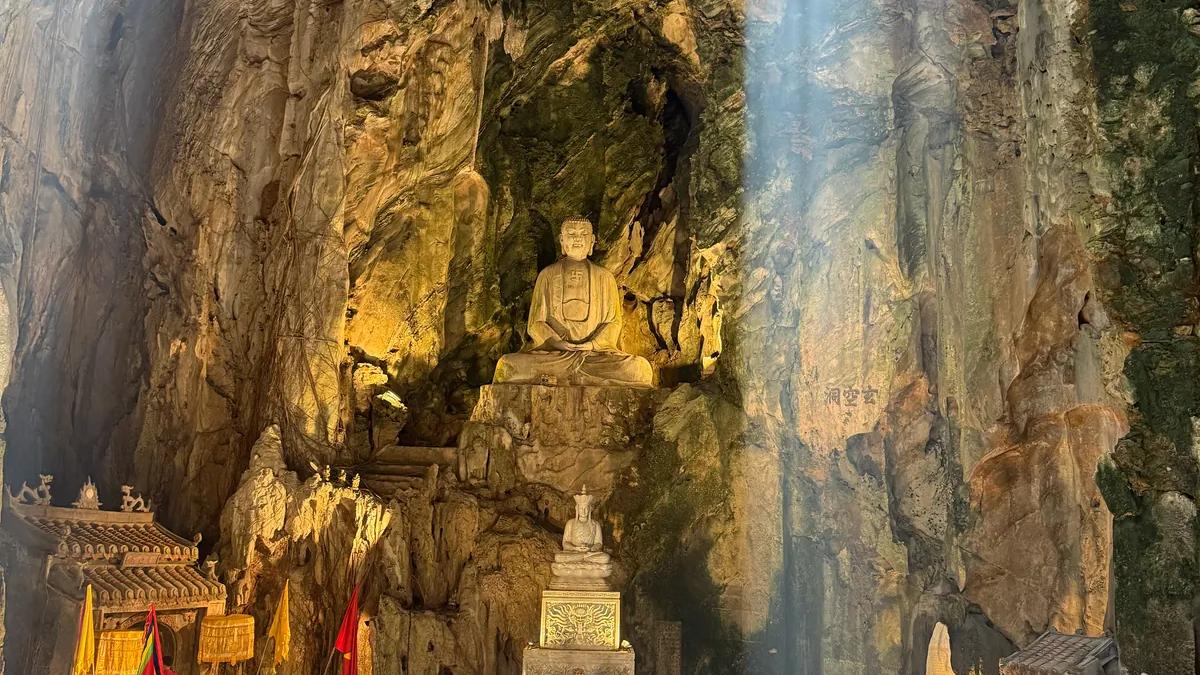
Huyen Khong is one of the most memorable spaces on Thuy Son. Its scale and openings in the rock create a setting in which changing light affects what you notice first. On some occasions, a shaft of sunlight becomes the dominant feature; at other times, the stone and shrines hold the attention.
That light is a natural effect, not something a guide can guarantee for a particular photograph. Cloud, season and time of day all matter. Enter with an interest in the whole space and you can appreciate it even when it looks different from promotional images.
Look for the relationship between the cave walls and the religious figures placed within them. People have given spiritual meaning to an existing landscape. This makes the cave both a natural formation and a cultural place, with responsibilities for visitors in each role.
Pagodas inscriptions and layers of history
Tam Thai and Linh Ung are important parts of the Thuy Son visit. Their presence reminds visitors that these mountains have long drawn religious attention. Written traces on rock surfaces provide another way to approach the past, though an inscription needs interpretation rather than a quick guess based on its appearance.
A good question for a guide is who commissioned a particular feature, what the available evidence says and whether it has been restored. A surviving text, a later reconstruction and a local legend can all enrich a visit, provided their different roles are explained.
Follow the material into Non Nuoc
At the foot of the mountains, Non Nuoc stone carving introduces the working knowledge behind finished objects. A workshop or the local museum of stone-carving memory can help explain tools, materials and changing production methods.
When visiting, ask how the stone is selected and which stages require the most control. Notice the difference between shaping a broad form and refining a small detail. Those questions give the craft more depth than simply browsing a display of finished souvenirs.
Do not assume that a piece offered for sale was quarried from the protected mountains beside you. Material origin and workshop production are separate questions, and a responsible seller should be able to discuss the product being offered.
Plan for steps rather than just distance
The site can involve stairs, uneven surfaces and enclosed passages. An elevator may reduce part of the ascent, but it does not make every cave and viewpoint step-free. Tell your guide about mobility concerns before booking so the route can be chosen realistically.
Wear footwear with grip, carry drinking water and allow time to rest. After rain, pay particular attention to surfaces. If part of the route feels unsuitable, skipping that section can protect the enjoyment of the rest of the visit.
Leave with a clearer story
A thoughtful Marble Mountains visit can connect three things: the formation you see, the spiritual meaning people have given it and the skills practised nearby. You do not need to remember every name to understand those relationships.
Ask Tommy to build the stop around the aspects that interest you most, whether that is cave architecture, religious context or the craft tradition of Non Nuoc.
Frequently asked questions
Why are there six peaks if the name refers to five elements?+
Hoa Son consists of two peaks, Am Hoa Son and Duong Hoa Son. The five elemental names therefore correspond to six physical hills.
Does the elevator remove all the climbing?+
No. It assists with part of the ascent; steps and uneven routes remain elsewhere. Discuss the exact route if accessibility matters to your group.
Will Huyen Khong Cave always have dramatic sunbeams?+
No. The light depends on weather and timing. The cave's cultural and spatial qualities remain worth exploring without that effect.