
Travel guide
Champa and My Son Sanctuary Through Tommy's Eyes

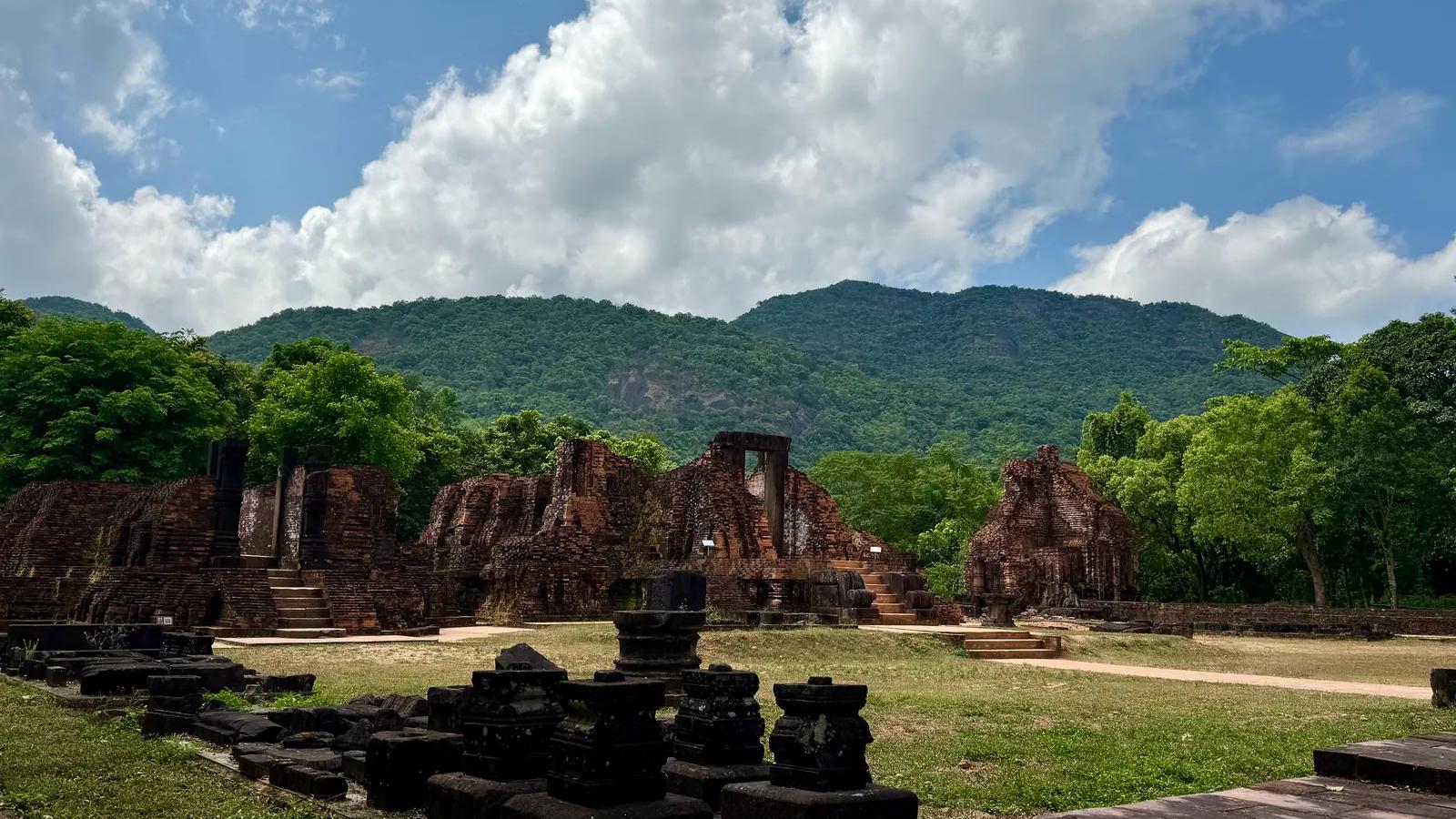
My Son helps explain a history of central Vietnam that begins long before the merchant houses and assembly halls familiar to visitors in Hoi An. Its brick towers belonged to the religious world of Champa, whose rulers, builders and sculptors made this valley a place of devotion and royal patronage. Reading the sanctuary alongside the wider Thu Bon landscape reveals how sacred places, political centres and trading connections could support one another without being the same kind of settlement.
For me, as a guide from Hoi An, this is the most useful starting point. A journey to My Son should deepen our understanding of the region. It should also give Champa its own place in the story, with its own religious ideas and artistic achievements. The towers are more than a picturesque introduction to a day trip. They are evidence of people who shaped the land before the surviving streetscape of Hoi An took form.
This article follows that relationship from the kingdom to the sanctuary, then from the architecture to the sculptures. Along the way, it distinguishes the age of a sacred foundation from the age of a surviving wall, and the history of an ancient kingdom from the continuing lives of Cham communities.
Understanding Champa as a changing historical world
The phrase "Kingdom of Champa" is convenient, but it can make the past seem more uniform than it was. Modern scholarship questions the older picture of a single, permanently centralised kingdom divided into stable provinces. It instead examines changing territories, regional centres, political relationships and connections beyond the coast. The fall of Vijaya in 1471 was a major historical rupture, but it should not be treated as the disappearance of every Cham political institution or the end of Cham history. [2]
This distinction changes the questions we ask at My Son. Rather than assuming that every temple belonged to one uninterrupted royal programme, we can ask who commissioned a particular monument, when it was rebuilt, which deity it honoured and how its patron sought to establish authority. A sanctuary used over many generations naturally contains different ambitions. Later builders could recognise an older sacred place while expressing their own claims within it.
The word "kingdom" also directs attention towards kings, whereas the buildings depended on many forms of work. Preparing materials, moving stone, shaping bricks, carving figures and maintaining a ritual establishment required practical knowledge as well as political support. Although the names of individual workers are often unavailable, their skill remains visible. A wall is therefore evidence of organised labour as much as it is evidence of a ruler's devotion.
The regional approach helps avoid another mistake: imagining Champa as an isolated civilisation. The research collected in Champa: Territories and Networks of a Southeast Asian Kingdom examines connections with India, China, mainland Southeast Asia and the Malay world. These connections invite us to see artistic exchange as a historical process involving selection and adaptation. They do not justify treating every similar motif as proof that the same people built monuments in different countries. [2]
Why the valley became a royal sanctuary
My Son occupies a valley enclosed by mountains in the historical Quang Nam region. Its historical ensemble comprised more than seventy brick and stone structures, most dedicated to Shiva. That number refers to the historical architectural ensemble, including buildings known through remains and documentation; it should not create an expectation of seventy complete towers standing today. [1]
The site authority connects the early foundation with King Bhadravarman in the fourth century and describes renewed construction under Sambhuvarman in the seventh century. These milestones concern the development of a sacred establishment. They do not mean that every visible monument dates from the fourth century. [3]
A religious foundation can outlive its first building. A shrine may be replaced, enlarged or incorporated into a later complex while retaining its prestige. That is the distinction to keep in mind when reading a date on an introductory panel: the beginning of worship, the construction of a particular tower and the date of a surviving sculpture answer different questions.
The valley setting also matters. My Son's official interpretation relates the surrounding mountain, the stream and ritual water to the sacred meaning of the site. Water was used in ceremonies associated with the linga and yoni. These associations help explain why the landscape belonged to the religious experience, rather than merely forming a scenic background. [3]
I would describe My Son first as a royal sanctuary with strong political significance. Calling it an "imperial city" suggests residential streets, markets and an administrative centre that the surviving temple ensemble does not itself demonstrate. Nearby Tra Kieu belongs in the discussion of political settlement. Keeping these roles distinct makes their relationship more interesting: a ruler could draw authority from a sacred place beyond the principal urban centre.
Shiva worship and the connection between devotion and power
Shiva is central to understanding My Son. The early sanctuary is associated with Bhadresvara and with worship through the linga and yoni. These are sacred forms, and explanations should begin with their religious significance rather than reduce them to an amusing visual comparison. The site authority interprets their relationship through generative power and the bringing forth of life. [1, 3]
For a visitor unfamiliar with Hindu traditions, it helps to distinguish an image of a deity in human form from another sacred form through which that deity is worshipped. Recognition does not depend entirely on seeing a face or a figure. A sanctuary can organise attention around a sacred object whose meaning comes from ritual, belief and its place within the building.
Royal patronage adds another dimension. Commissioning a temple made devotion material and visible. In my reading, such an act could also place a patron within an established sacred tradition: the builder was supporting a place whose importance extended beyond an individual reign. That interpretation gives us a way to connect religion and power without assuming that every architectural detail was simply political propaganda.
We should also avoid imagining that the emphasis on Shiva excluded all other religious imagery. The Brahma and Vishnu scene associated with E1 and the Ganesha sculpture from E5 demonstrate a wider visual vocabulary within the sanctuary's predominantly Shaivite setting. The presence of these figures makes it possible to discuss relationships among deities, stories and ritual spaces instead of assigning one religious label to every object. [1]
Reading a temple group as a sequence of spaces
A productive way to look at My Son is to move from the arrangement of buildings to their details. Start by asking which structure held the principal shrine and how someone approached it. Then examine the neighbouring buildings. Their different shapes may reflect different roles rather than incomplete attempts to build the same tower.
The Department of Cultural Heritage identifies several recurring components: the kalan, or main sanctuary; the gopura, or gateway; the mandapa, a hall associated with pilgrims and offerings; and the kosagraha, a building used for ritual objects. Individual groups differ, and these names should not be turned into an inflexible plan applied to every ruin. [4]
The arrangement suggests a sequence of approach, preparation and worship. In architectural terms, access itself becomes meaningful. A gateway marks a threshold; a hall provides another kind of space; the sanctuary concentrates religious attention. This is an interpretive reading of the plan, not a claim that every visitor in every period followed an identical ceremony.
The distinction is especially useful for people arriving from Hoi An Ancient Town. A merchant house, an assembly hall and a Cham tower temple solve different problems. One may combine domestic life and commerce; another may serve a community's collective worship and association; the tower temple focuses on its sacred centre. Comparing them begins with function, before comparing roofs or decorative motifs.
Even a damaged group can communicate these relationships. Missing upper walls do not erase a foundation plan, and a surviving doorway can still help establish orientation. A thoughtful visit therefore gives time to the spaces between monuments. Those intervals can explain how the ensemble worked more clearly than a sequence of close-up photographs of individual towers.
Brick and sandstone as evidence of knowledge
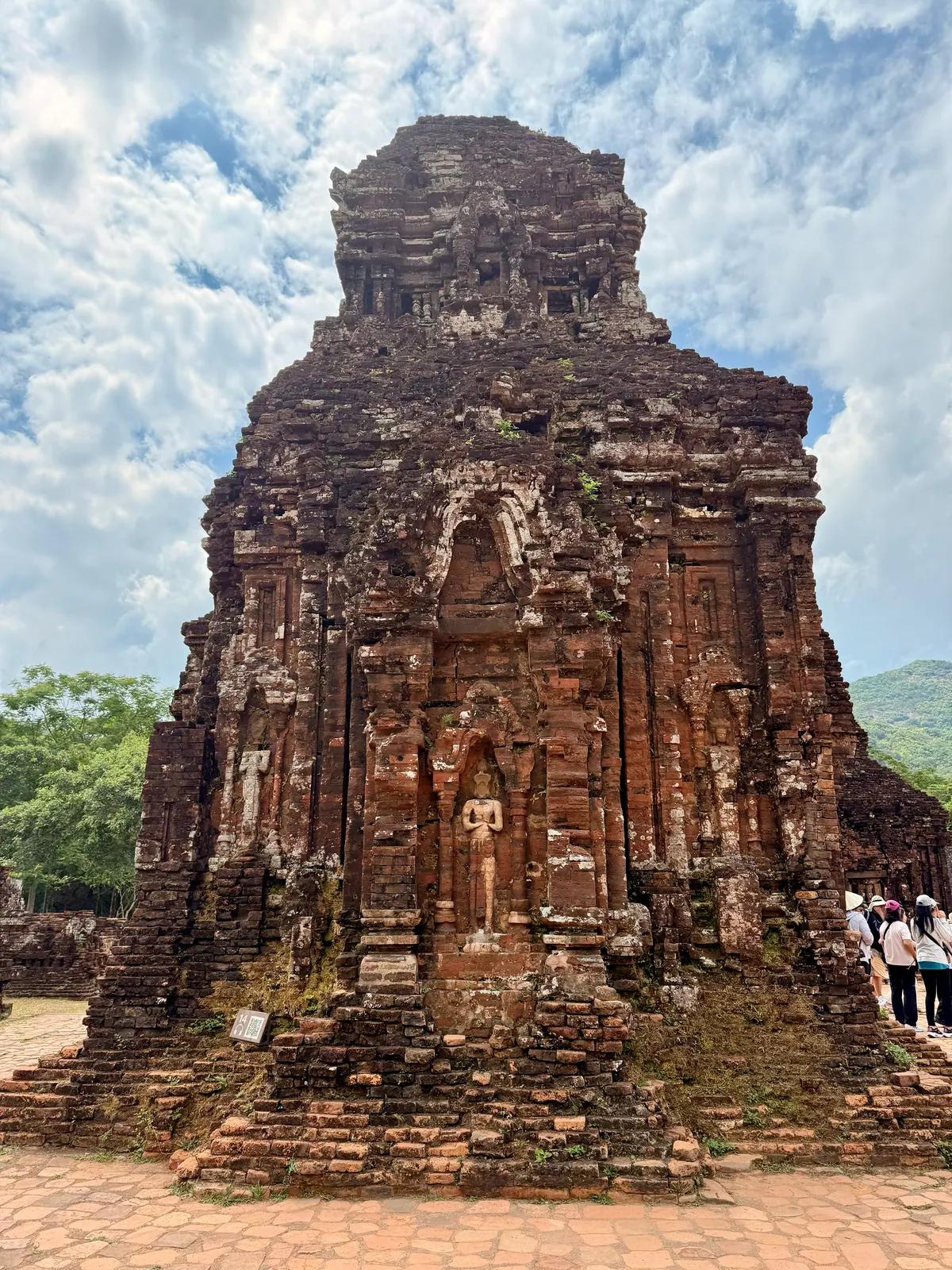
My Son combines fired brick construction with sandstone sculpture and preserves a succession of artistic styles rather than a single design repeated unchanged. Looking closely, the material contrast becomes a useful guide: broad masses of brick establish the building, while stone elements can carry concentrated figurative or architectural detail. [1]
A tower can first be read through its base, body and upper structure. This simple division helps the eye follow how the building rises. From there, attention can move to the rhythm of wall surfaces, projections, niches and carved details. The point is to recognise an organised composition before trying to identify every motif.
Visitors often hear that Cham brickwork has "no mortar" or that its construction remains an entirely unexplained secret. The official conservation discussion is more specific. It examines brick properties, bonding materials, stone deterioration and the performance of restoration treatments. It also acknowledges unresolved questions. This is a field of material investigation, not evidence that scientific study has learned nothing. [5]
The distinction between an ancient material and a modern repair is essential. A substance used in a conservation project does not automatically establish the original recipe for every tower. Likewise, the colour of a brick cannot by itself provide a reliable construction date. We should let technical questions remain technical when the available evidence does not support a simpler answer.
To me, the achievement becomes more impressive when it is described through skill. The builders had to coordinate the properties of their materials with the shape and purpose of the structure. The sculptors had to make a surface legible within an architectural setting. Wonder need not depend on a mystery story; it can arise from recognising how much judgement is contained in an apparently simple wall.
The sculptures make the sanctuary more human
The surviving sculptures bring the discussion from whole buildings to individual acts of looking. The My Son collection at the Cham sculpture museum is particularly valuable because objects can be connected with their original architectural contexts. A sculpture should not be treated only as a freestanding masterpiece if it once formed part of a doorway, pedestal or shrine. [1]
The Birth of Brahma at My Son E1
The relief commonly called The Birth of Brahma once crowned the entrance to the E1 temple. Its scene includes Vishnu reclining upon a serpent, with a lotus emerging from his navel and Brahma associated with the lotus. The composition expresses a story of cosmic creation. The work entered the museum in 1935. [1]
There are two useful scales of interpretation. At the first, we identify the figures and the story. At the second, we ask what it meant to position that story over an entrance. A visitor approached a sacred interior beneath an image concerned with the formation of the world. That relationship between narrative and location can make the sculpture more intelligible than a list of deity names alone.
Aspects of the composition have been compared with Indian, Khmer and Mon artistic traditions. Such comparisons are best understood as tools for studying artistic relationships. A resemblance does not establish that the work was imported, nor does it remove the agency of the Cham artists who shaped the composition. [1]
The E1 pedestal and images of religious life
The museum's presentation of the E1 pedestal draws attention to ascetics and musical scenes, including figures associated with string and wind instruments. These details introduce activities and gestures into a discussion often dominated by kings and gods. [6]
The distinction matters because religious art is also a way of organising human presence. Posture, movement and relationships between figures can give a viewer an entry into a work even before its full iconography is understood. Looking carefully at one figure may be more rewarding than rushing through a long catalogue of styles.
It would nevertheless be misleading to treat every carved scene as a literal documentary photograph of daily life. These images belong to an artistic and sacred programme. They offer evidence, but evidence that needs interpretation. Their greatest value for a first-time visitor may be the way they reveal that the sanctuary's visual world contained bodily movement, skilled activity and social relationships.
Ganesha and the importance of an original setting
A standing Ganesha sculpture was found at E5 during the 1903 investigations. Its elephant head and multiple arms give a visitor a recognisable starting point. Yet the more useful historical question is how the image related to the shrine and the broader group in which it stood. [1]
Seeing an object in a museum and seeing its original site can therefore be complementary experiences. At the museum, a viewer may study details under clearer conditions. At the sanctuary, the same viewer can consider scale, orientation and proximity to other buildings. Neither setting alone supplies the entire history.
Many building periods within one sanctuary
The alphabetic labels at My Son are modern tools of documentation. Henri Parmentier and Charles Carpeaux used letters for groups and numbers for individual buildings during the investigations of 1903-1904. A1, for example, identifies the principal monument in Group A. The sequence of letters is not a chronological list of dynasties. [1]
This prevents a common misunderstanding. Moving from one labelled group to another does not necessarily mean moving forward in time. A group may contain buildings of different dates, and a single monument may preserve evidence of more than one phase. The sanctuary is better approached as an accumulated record than as a neatly ordered exhibition.
The stylistic vocabulary includes My Son E1, Hoa Lai, Dong Duong, My Son A1 and later developments. These names allow specialists to compare form and decoration, but a style label should be distinguished from an exact date secured by an inscription. Architectural comparison, archaeological context and written evidence contribute different kinds of information. [1]
For a general reader, the essential point is that change is part of the site's identity. Differences in proportion or ornament are not distractions from an original "pure" My Son. They are among the reasons the sanctuary is historically valuable. It preserves traces of decisions made across generations.
Destruction and the responsibility of conservation
A1 has a particular place in this story. A major achievement of Cham architecture, it was destroyed by American bombing in 1969. Its earlier documentation consequently matters when trying to understand a monument that cannot now be experienced in its former state. [1]
That loss changes the visitor's task. Surviving walls must sometimes be read alongside photographs, plans, fragments and records. A gap in an ensemble is part of its history, although it should not be filled with confident imaginative detail. Reconstruction in words requires the same distinction between evidence and speculation that reconstruction in masonry demands.
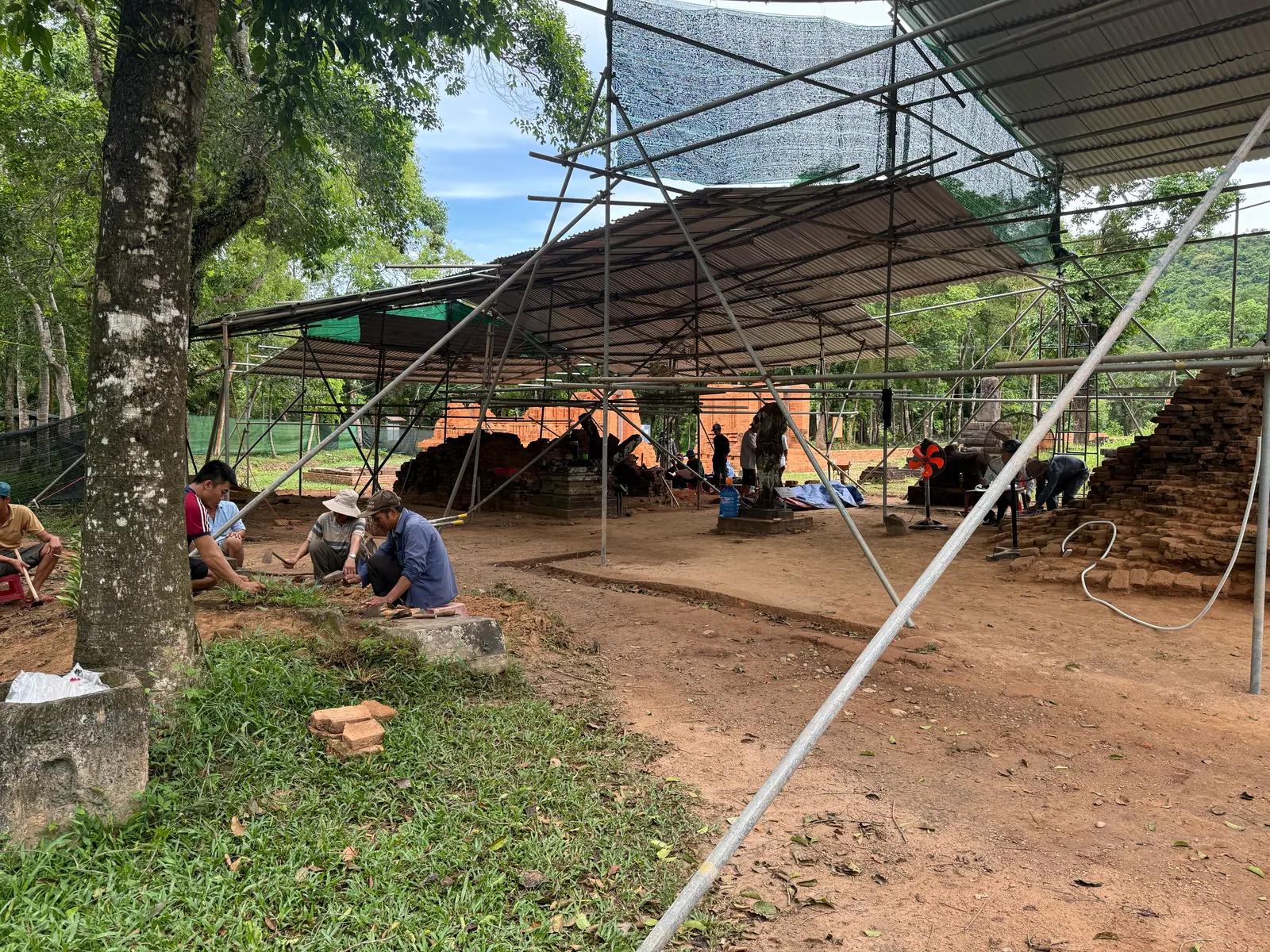
Conservation also continues after the dramatic events of war. The site authority discusses moisture, biological growth, salts and deterioration affecting exposed materials and some restored surfaces. Protecting a monument therefore involves studying how it behaves over time, not merely completing a visible repair. [5]
From a visitor's perspective, a repaired section may appear less picturesque than an aged surface. Its purpose, however, should be judged through conservation evidence rather than photographic preference. Equally, a convincing appearance alone cannot establish that an intervention is historically accurate. These are reasons to value patient documentation and monitoring.
My Son was inscribed on the UNESCO World Heritage List in 1999 under criteria concerning cultural interchange and testimony to a historical civilisation. That recognition draws attention both to the artistic achievement and to the significance of its preservation. [7]
My Son and Hoi An within the Thu Bon landscape
My Son, Tra Kieu and the lower Thu Bon River region become more understandable when considered together. The Hoi An heritage authority discusses the river basin through the relationships between inland areas, political centres and maritime exchange during the periods of Lam Ap-Champa and, later, the Nguyen lords. The river connected places with different functions and resources. [8]
The relationship is best expressed without collapsing all those places into one city. My Son provides evidence of sacred patronage. Tra Kieu contributes to the study of an urban and political centre. The lower river and coastal zone belong to the history of movement and exchange. These roles could be related while remaining spatially and institutionally distinct.
The argument also requires a distinction between continuity of landscape and continuity of institutions. A river can remain important while its channels, settlements, political authorities and trading networks change. The familiar later port history of Hoi An cannot simply be projected backwards onto the Champa period. [8]
For my interpretation as a Hoi An guide, this makes the region more compelling. The connection does not need an invented direct line from one tower to one merchant house. It rests on a landscape repeatedly used and understood by different communities, from the sanctuary in the hills to the rice fields and villages of the countryside. The task is to explain those successive relationships carefully.
Why Cham architecture differs from the later architecture of Hoi An
The Vietnamese, Japanese and Chinese influences associated with Hoi An belong to a different architectural and social setting. The Japanese Covered Bridge and the Chinese assembly halls are characteristic elements of that historical townscape. My Son's main subject is the Cham tower temple and its religious establishment. [1]
It would be inaccurate to present My Son as another example of the same Vietnamese, Japanese and Chinese architectural combination. Its principal religious imagery and its tower forms belong to a different historical framework. A shared location in central Vietnam does not make every monument an expression of the same cultural mixture.
There is, however, a useful comparison in the act of adaptation. At My Son, Cham patrons and artists worked with religious ideas and artistic vocabularies circulating beyond their immediate region. In Hoi An, different communities also shaped buildings through local conditions and wider connections. The comparison concerns a process; it does not imply identical origins, purposes or forms.
I would encourage readers to compare a doorway with a doorway only after asking what each building was for. Who crossed the threshold? What activity took place inside? Was the building a shrine, a community institution, a residence or a place of business? Those questions produce a more convincing architectural account than simply identifying roofs as "foreign" or "local".
Cham heritage continues beyond the ruins
An account of Champa should not end by calling the Cham a vanished people. UNESCO's 2022 inscription of the art of pottery-making of Cham people on the List of Intangible Cultural Heritage in Need of Urgent Safeguarding provides one clear example of a living tradition. Its description emphasises women's creativity and the transmission of knowledge within communities. [9]
This is not a claim that contemporary pottery proves how ancient temple bricks were made. Those are different practices with different bodies of evidence. The connection is the responsibility to recognise living people alongside ancient monuments and to avoid treating present-day communities as illustrations of an unchanging past.
A thoughtful account leaves room for Cham voices to explain their own traditions and circumstances. Archaeologists can interpret buried remains; conservators can discuss materials; communities can speak about the knowledge and practices they maintain. These perspectives are related, but none should automatically stand in for all the others.
A way of looking with Tommy
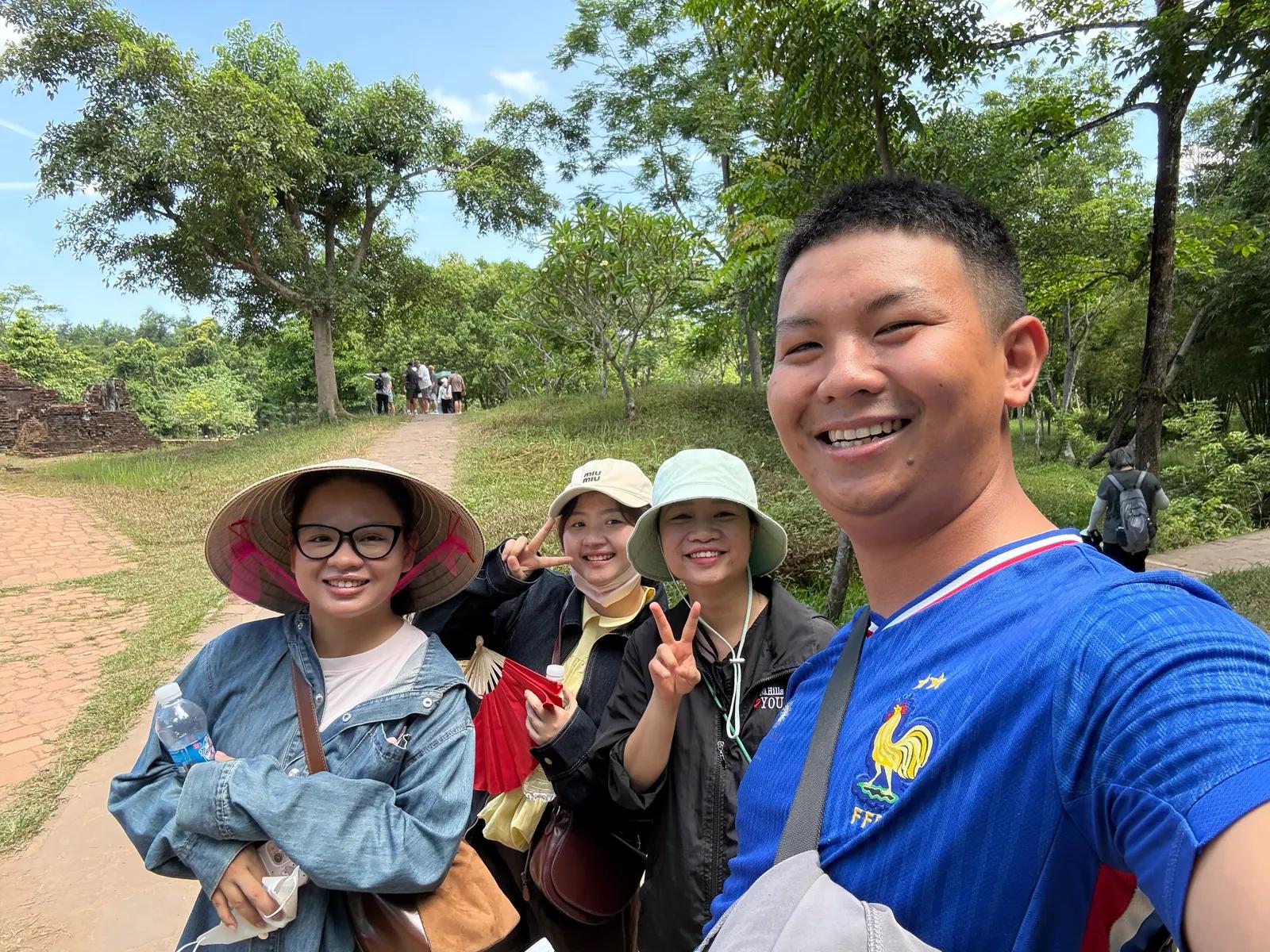
My preferred reading of My Son begins with the valley, moves to the arrangement of a temple group and then slows down at a single detail. That sequence lets the visitor understand the relationship between setting, building and image. It also gives enough space for questions rather than requiring a long list of facts to be memorised.
A carved figure can open a discussion of belief. A change in brickwork can prompt a question about building phases or conservation. A missing monument can lead to the history of documentation and loss. Each observation should be connected to evidence, with uncertainty explained where it remains.
When the journey returns to Hoi An, the town can then be seen within a longer regional history. Its merchant streets remain distinctive, while the earlier Champa landscape gains its own clarity. For me, that is the value of placing My Son within a wider story of Quang Nam: it allows different communities, periods and kinds of achievement to remain visible together.
Walk the valley with the Champa story in mind, from the temple groups to the carvings and the landscape that gave them meaning, on the My Son Sanctuary private tour.
Keep Reading
Champa is the first chapter of a longer Quang Nam story. Follow it downstream to Thu Bon River: Understanding Hoi An Through the Water, then to How an International Trading Port Created the Hoi An We See Today and the streets of Hoi An Ancient Town: More Than a Beautiful Old Town. To compare building traditions, see Hoi An Architecture: Reading History Through Houses, Roofs and Courtyards, and for the landscape between the sanctuary and the sea, see Authentic Hoi An Countryside: Village Life Beyond the Ancient Town. If you would rather hear all of this on site, see Hoi An Tour Guide: How to Hire a Licensed Local Guide.
Sources and further reading
[1] Bai Giang ELVN Hoan Chinh. Teaching document supplied by Tommy. Sections on the My Son gallery, My Son Sanctuary and Hoi An monuments.
[2] Arlo Griffiths, Andrew Hardy and Geoff Wade, editors. Champa: Territories and Networks of a Southeast Asian Kingdom. EFEO, 2019. https://publications.efeo.fr/en/livres/932_champa
[3] Van Khoa. Cac gia tri dac biet cua Khu di tich My Son. My Son heritage management website, 21 June 2021. https://disanvanhoamyson.vn/tin-tuc/cac-gia-tri-dac-biet-cua-khu-di-tich-my-son.html
[4] Department of Cultural Heritage of Vietnam. Di tich kien truc nghe thuat Khu den thap My Son. https://dsvh.gov.vn/di-tich-kien-truc-nghe-thuat-khu-den-thap-my-son-2943
[5] My Son heritage management website. Nhung ket qua buoc dau trong cong tac bao quan vat lieu o Di san Van hoa The gioi My Son. https://disanvanhoamyson.vn/tin-tuc/nhung-ket-qua-buoc-dau-trong-cong-tac-bao-quan-vat-lieu-o-di-san-van-hoa-the-gioi-my-son.html
[6] Da Nang Museum of Cham Sculpture. My Son Gallery. Online exhibition on Google Arts & Culture. https://artsandculture.google.com/story/uwXxZLZeH8-MJA
[7] UNESCO World Heritage Centre. My Son Sanctuary. World Heritage List, property 949. https://whc.unesco.org/en/list/949/
[8] Hoi An heritage conservation authority. Thu Bon, Tra Kieu, Hoi An trong mang luoi thuong mai thoi Lam Ap, Champa va thoi chua Nguyen. https://hoianheritage.danang.gov.vn/vi/trao-doi-chuyen-nganh/chuyen-de-nghien-cuu-trao-doi/thu-bon-tra-kieu-hoi-an-trong-mang-luoi-thuong-mai-thoi-lam-ap-champa-va-thoi-chua-nguyen-905.html
[9] UNESCO Intangible Cultural Heritage. Art of pottery-making of Cham people. Inscribed in 2022. https://ich.unesco.org/en/USL/art-of-pottery-making-of-chm-people-01574
Frequently asked questions
Is My Son the same as an ancient Cham city?+
No. My Son is best understood as a royal sanctuary with strong political significance, not an urban centre with streets and markets. Nearby Tra Kieu belongs to the discussion of political settlement. Keeping the two roles distinct makes their relationship easier to understand.
How old are the towers at My Son?+
The sacred foundation is connected with King Bhadravarman in the fourth century, with renewed construction under Sambhuvarman in the seventh century. That is the age of the religious establishment, not of every standing wall. The sanctuary contains many building periods, so the date of worship, the date of a tower and the date of a sculpture are three different questions.
Why is My Son mostly dedicated to Shiva?+
The early sanctuary is associated with Bhadresvara and with worship through the linga and yoni, sacred forms interpreted through generative power and the bringing forth of life. Other deities appear too, including the Brahma and Vishnu scene from E1 and a Ganesha from E5, so the setting is predominantly Shaivite rather than exclusively so.
Do the letters A, B, C and E at My Son show the order the temples were built?+
No. The letters are modern documentation labels used by Henri Parmentier and Charles Carpeaux during the investigations of 1903 and 1904. Groups can contain buildings of different dates, and a single monument may preserve more than one phase.
How should I combine My Son with a visit to Hoi An?+
Treat them as two chapters of the same Thu Bon landscape rather than the same architecture. Visit My Son early in the day when it is cooler and quieter, then read the Ancient Town afterwards. The contrast between a Cham tower temple and a merchant house or assembly hall is the most useful thing you can take from the pairing.
Are the Cham a vanished people?+
No. Cham communities and their traditions continue today. UNESCO inscribed the art of pottery-making of Cham people on the List of Intangible Cultural Heritage in Need of Urgent Safeguarding in 2022, a recognition that emphasises women's creativity and the transmission of knowledge within living communities.