
Travel guide
Authentic Hoi An Countryside: Village Life Beyond the Ancient Town

Most travelers first meet Hoi An through yellow houses, lanterns, old merchant homes and the Japanese Covered Bridge.
That is an important part of Hoi An. But it is not the whole story.
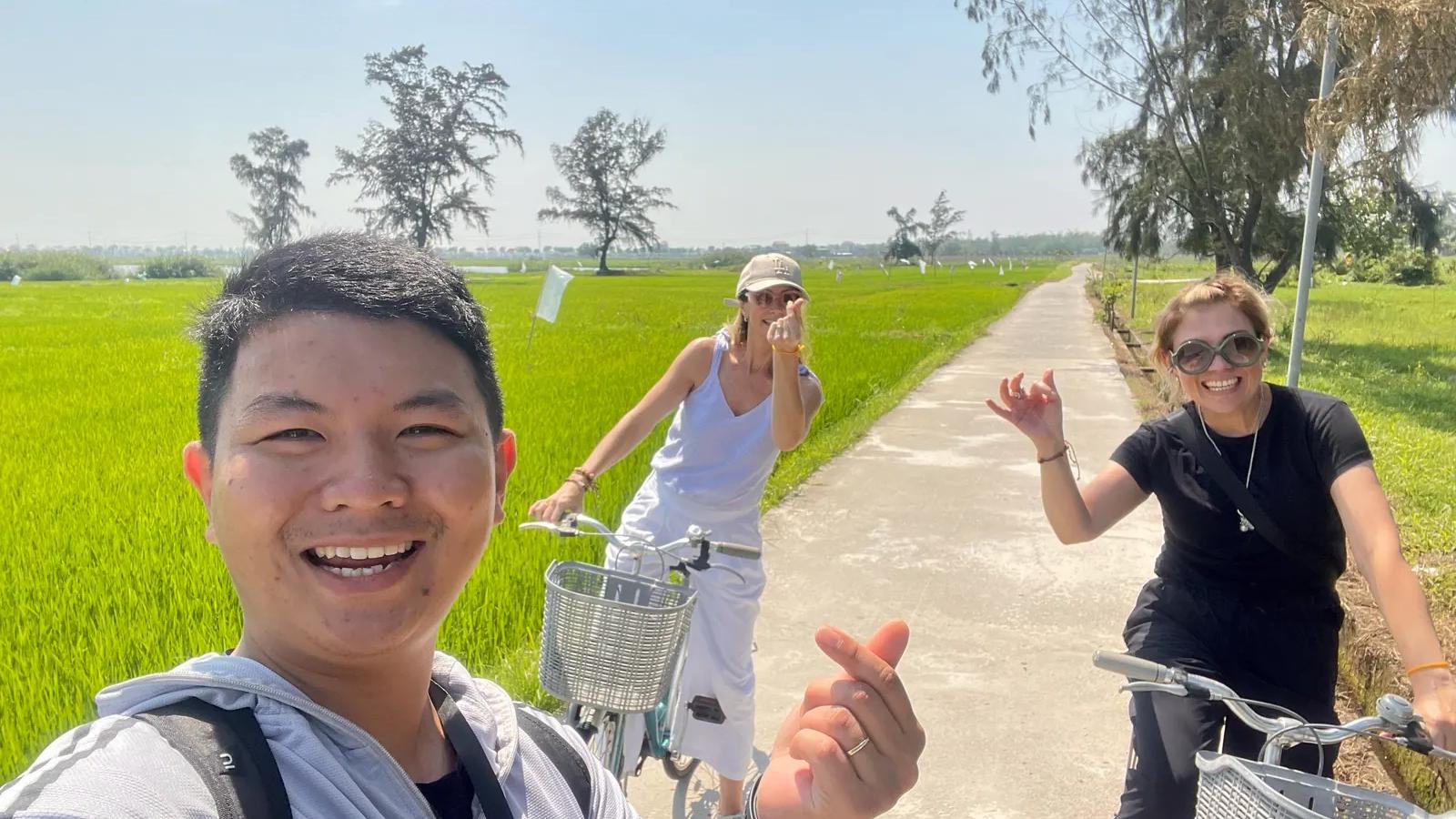
The Hoi An I grew up with was also a river. A small ferry. A bicycle road between rice fields. Farmers working under the morning sun. Fishing families living beside the waterways. The sound of tools inside a village workshop. Clay turning slowly beneath the hands of an experienced potter. And family journeys that had nothing to do with tourism.
When I was a child, crossing the river toward Cam Kim was not an "authentic countryside experience." It was simply part of life.
Today, when travelers ask me how to see the real Hoi An, I often think about those memories. Because sometimes the best way to understand Hoi An is to leave the Ancient Town behind for a few hours. Cross the river. Follow the small roads. And meet the people whose daily lives have always been part of the wider Hoi An story.
Hoi An has always been more than the Ancient Town
Hoi An became an important commercial center because it was connected to a much larger landscape. During the 16th and 17th centuries it was one of the busiest commercial ports in Central Vietnam, visited by trading ships from many countries, and Chinese and Japanese influences became part of the town's architecture and community life.
But a trading town does not survive on merchants alone. People need food. Boats. Wood. Clay. Tools. Fish. Vegetables. Crafts. Transportation. And labor.
Behind the prosperous merchant town was another world: farmers, fishermen, craftspeople and small village communities.
This is why I do not see the countryside as something separate from Hoi An. It is the landscape behind the town. The Ancient Town tells the story of exchange. The countryside tells the story of production, livelihood and everyday life. Together, they make Hoi An complete.
Authenticity begins with people, not activities
The word authentic is used so often in tourism that it can easily lose its meaning. An "authentic experience" is sometimes presented as a list: ride a bicycle, plant a vegetable, take a basket boat, make a piece of pottery, take photographs and return to the hotel.
But completing local activities does not automatically mean understanding local life.
For me, authenticity begins with a different question: who are the people behind the experience?
If we visit a farm, who works there when tourists are not present? If we take a basket boat, why did local people originally need that boat? If we make pottery, how long did it take an artisan to master the movement that we attempt for ten minutes? If we enter a woodworking village, how does that craft connect with the houses and boats we see around Hoi An?
The activity is only the entrance. The human story is the real experience.
The land: understanding Hoi An through its farmers
The countryside begins with the land. Around Hoi An, agricultural communities have long depended on soil, water, weather and seasonal knowledge. For travelers, a field may look peaceful. For a farmer, it is a workplace.
What appears simple from the roadside can involve years of practical knowledge: when to plant, how much water a crop needs, how weather affects the soil and how to recognize problems before they become visible to someone without farming experience.
This is why places such as Tra Que or the farming areas around An My should not be introduced only as beautiful vegetable gardens. They are classrooms.
From soil to the food on the table
One of the easiest ways to understand farming is to connect it with something every traveler already knows: food.
A plate of herbs in Hoi An may look like a small detail beside cao lau, mi quang or another local dish. But before those herbs reach a restaurant table, somebody has worked the soil. Somebody has managed the water. Somebody has planted, maintained, harvested and prepared them.
That creates a simple but powerful connection: soil, farmer, ingredient, kitchen, local food.
Once visitors see that chain, food becomes more meaningful. A countryside experience should therefore not end with "I planted vegetables." It should lead to "now I understand where part of Hoi An's food culture begins."
What farming taught me as a local guide
Working alongside local farmers changed the way I talk about agriculture.
Watching somebody who performs the same task every day is very different from trying it yourself. An experienced farmer moves naturally. A visitor usually does not. Tools feel unfamiliar. The posture is difficult. Movements that look easy from a distance suddenly require concentration.
That experience creates humility. It reminds us that farming should not be reduced to an entertaining photo opportunity. For a visitor it may be an hour. For another person, it is a livelihood.
The water: another side of Hoi An life
If farming explains Hoi An through the land, fishing communities explain it through water.
Rivers, smaller waterways and the coast have always been important parts of life in Central Vietnam. Water provides food, transport, movement, connections between villages and sometimes danger.
The historical development of Hoi An itself was closely connected with its riverside location and commercial access. In the countryside, the same water has a more intimate meaning. It belongs to ordinary families.
Cam Thanh: look beyond the basket boat
Today, many visitors know Cam Thanh because of the basket boat. It is colorful. It is photogenic. And in some places it has become entertainment.
There is nothing automatically wrong with tourism becoming part of the local economy. Communities change. People adapt.
But the basket boat becomes much more interesting when we ask: why did people need this boat before tourists arrived?
Then we can begin talking about fishing, waterways, nipa palms, local knowledge, family livelihoods and the relationship between people and the river environment.
A basket boat separated from those stories becomes an attraction. A basket boat understood within those stories becomes culture.
Authentic does not mean untouched by tourism
Sometimes travelers imagine that an authentic village should have no modern houses, no smartphones, no motorbikes and no tourism businesses. But local people do not exist to recreate the past for visitors.
Communities develop. Farmers use new equipment. Craftspeople sell online. Young people choose different careers. Fishing families may also work in tourism. A village can change and still remain real.
Authenticity should not mean "people must live exactly as their grandparents did." A better definition is real people, real community, real adaptation. The goal is not to freeze local culture. The goal is to understand how it changes.
Cam Kim and my childhood Hoi An
Cam Kim is especially important to me because my connection with the area began long before I became a tour guide.
I remember taking my bicycle onto a small ferry to cross the river and visit my grandparents. After the crossing came the village roads, rice fields, houses, small boats and quiet spaces. For me, there was nothing exotic about it. I was simply going to see family.
Today, when I return to countryside areas with travelers, that memory influences the way I introduce them. A village is not a tourism product first. It is someone's home. A road that appears beautiful to a traveler may be the road someone has taken to school for twenty years. A river crossing may remind someone of their childhood. A rice field may support a family.
The meaning of a place changes completely when we remember that.
Bach Dang, the Hoai River and the road out of town
The countryside also helps connect places that visitors often experience separately: Bach Dang Street, the Hoai River, Cam Kim, the Ancient Town, village roads and rice fields. They are not isolated attractions. For local people, they are part of one continuous landscape.
This is why I prefer to explain Hoi An through connections rather than stops. Instead of saying "now we finish attraction number one and go to attraction number two," I prefer "this river explains how the town connects with the countryside." That changes the experience from itinerary to story.
The hands: traditional crafts tell another story
The Hoi An countryside is not only land and water. It is also hands. Hands cutting wood. Hands shaping clay. Hands repairing boats. Hands weaving. Hands preparing tools.
Traditional skills are one of the clearest ways to understand how knowledge moves between generations. This is where places such as Kim Bong and Thanh Ha become particularly valuable.
Kim Bong: the hands behind the wooden town
Walk through Hoi An Ancient Town and wood is everywhere: doors, pillars, beams, furniture and carved decoration. Boats also depended heavily on timber craftsmanship. That creates a natural question: who made these things?
This is where Kim Bong becomes part of the Hoi An story. The Ancient Town allows visitors to see the finished heritage. A craft village helps them understand the skill behind it.
A deeper visit should ask how the skill is learned, how long mastery takes, what craftsmen traditionally made, how the work has changed, whether younger generations continue it and what happens when a traditional craft's economic purpose changes. These questions turn handicraft into heritage.
Thanh Ha: earth, hands and fire
Thanh Ha tells another story. Instead of wood, the material is clay. Instead of carving, there is shaping. Then comes fire.
On the surface, pottery can become a simple tourist activity: sit down, make a small object and take a photograph. But my own experience trying pottery taught me something more interesting. What looks effortless in the hands of an experienced artisan is difficult when you try it yourself. The clay moves unexpectedly. Pressure matters. Speed matters. Balance matters.
A movement that someone has repeated for decades can appear almost invisible. That is skill. And that is what visitors should leave understanding. Not simply "I made pottery," but "I understood how much knowledge exists inside a simple movement."
The finished object is not the most important part
A bowl is not only a bowl. A wooden carving is not only a souvenir. The object is the final result of material knowledge, tools, repetition, family learning, mistakes, adaptation and time.
When tourism focuses only on the souvenir, most of the cultural value disappears. When tourism focuses on the maker, the object becomes meaningful again.
Land, water and hands, plus a fourth layer: memory
For me there is a simple framework for understanding the Hoi An countryside. The land teaches us about farmers. The water teaches us about fishermen and river communities. The hands teach us about craftspeople.
But there is a fourth layer: memory.
Memory explains why these places matter beyond tourism. A farmer remembers seasons. A fisherman remembers the river. An artisan remembers who taught them. A local person remembers how a village looked before hotels and tour buses. And I remember crossing the river to visit my grandparents.
That fourth layer is what transforms countryside travel into storytelling.
Quang Nam gives Hoi An a much deeper cultural landscape
Hoi An does not stand alone. It belongs to a much larger cultural landscape. My Son, also in Quang Nam, was the most sacred place of the Champa kingdom and once contained more than 70 brick and stone structures, many dedicated to Shiva.
Today's farming villages are part of a modern Vietnamese landscape. But the wider region carries older cultural layers: Champa, trade, agriculture, religious traditions, Vietnamese settlement, craft villages and modern tourism. The countryside is not culturally empty space between major monuments. It belongs to a region shaped by centuries of human activity.
From My Son to Hoi An: different ways people used the landscape
My Son reflects a sacred landscape connected with Champa. Hoi An reflects commerce, migration and urban life.
The countryside between and around such places reminds us that history was never confined to monuments. People needed food, water, transport, materials, villages, work and families. When we see Central Vietnam only through temples, citadels and UNESCO monuments, we risk forgetting the ordinary people who supported those larger systems. The countryside gives them back a place in the story.
Royal heritage, merchant heritage and village heritage
Looking farther north toward Hue creates another useful contrast. Hue combines royal heritage and folk culture, holds many traditional handicraft villages and is an important Buddhist center.
This helps explain why Central Vietnam cannot be represented by one single kind of heritage:
- Hue: royal heritage. Palaces, tombs, court culture, Buddhism and traditional crafts.
- Hoi An: merchant heritage. Trading houses, assembly halls, international connections and river commerce.
- Quang Nam countryside: village heritage. Farmers, fishermen, craftspeople, rice fields, village roads, rivers and family life.
Kings and courts shaped the region. Merchants shaped the region. But so did farmers, fishermen, craftsmen and families.
Hoi An before mass tourism
Understanding countryside life also helps visitors understand how much Hoi An has changed.
Before tourism became such a large part of the local economy, many families depended more heavily on farming, fishing, handicrafts, small trade and manual work. These livelihoods shaped family relationships and community rhythms.
Tourism has created new opportunities. But it has also changed land use, employment, expectations and the economic value of cultural traditions.
The interesting question is therefore not "was life better before tourism?" That question is too simple. A better question is: how has tourism changed the relationship between local people, heritage and livelihood?
Tourism can preserve culture, or turn it into performance
Tourism can help support crafts. Farmers can earn additional income. Traditional activities can receive renewed attention. Young people may discover new economic value in local knowledge.
But tourism can also simplify culture. Fishing becomes a five-minute performance. Farming becomes a photograph. Pottery becomes a souvenir workshop. Village life becomes a backdrop.
The difference often depends on how the experience is designed. This is why interpretation matters.
A better countryside experience: see, learn, participate, connect
My preferred approach is simple.
First, see. Observe before doing anything. Then learn. Understand what you are looking at and why it matters. Then participate. Try something only when it is appropriate and respectful. Finally, connect. Connect the small activity with the larger culture.
A visitor sees herbs, then learns about farming, then tries a farming task and finally understands how those herbs connect with Hoi An's food. A visitor sees a basket boat, then learns about fishing, then experiences the waterways and finally understands why the boat exists. A visitor sees pottery, then meets an artisan, then touches the clay and finally understands that the object contains knowledge accumulated over years.
That final step, connect, is the most important.
Why small and private experiences work better in the countryside
Countryside experiences often lose their meaning when everything becomes rushed. Five minutes here. Ten minutes there. Take a picture. Move on.
Small groups and private experiences allow something different. There is time to ask another question, stay longer with a farmer, watch an artisan instead of immediately trying the activity, stop beside a rice field, have tea, change the route and talk.
Sometimes even silence is valuable. Authentic local life is often quiet. A tour does not need constant entertainment to be meaningful.
What visitors should take home from the countryside
A visitor might leave with a photograph, a ceramic object or a small wooden souvenir. Those are good memories. But the most valuable souvenir is understanding.
After visiting the countryside, I want travelers to return to Hoi An Ancient Town and see it differently: to look at a wooden house and think about craftsmanship, eat herbs and think about farmers, see the river and think about fishing and transport, and look at a boat and think about families whose livelihoods depended on water.
To understand that the beautiful town did not appear by itself. People made it.
The countryside is not behind Hoi An, it is part of Hoi An
We often speak about going "outside Hoi An" to visit the countryside. Geographically, that can make sense. Culturally, I think differently.
The countryside is not simply outside the story. It helped create the story. The town and villages depended on one another. River and land depended on one another. Merchants and producers depended on one another. Today tourism may separate these experiences into different products. History did not.
Final thoughts: the Hoi An I want travelers to understand
Hoi An will always be famous for its Ancient Town. And it should be. The old houses, assembly halls, temples and Japanese Covered Bridge preserve an extraordinary story of trade and cultural exchange.
But if you stop there, you see only one side. The other side is quieter. It is found in the countryside. In soil. Water. Wood. Clay. Hands. Family. And memory.
For me, an authentic Hoi An countryside experience is not about pretending that village life has never changed. It is about meeting people as they are today while understanding the traditions, work and landscape that shaped their lives.
Cross the river. Walk through the fields. Meet the farmers. Listen to the fishermen. Watch the craftspeople. Ask questions. Try something with respect. And occasionally, simply stop and observe.
Because Hoi An is not only something you visit. For many of us, it is home.
Experience the Hoi An I grew up with
Go beyond lanterns and famous landmarks. Cross the river, follow the village roads, meet local farmers, fishermen and craftspeople, and discover how everyday life connects with the history of Hoi An.
See the place. Understand the people. Connect with the story. The local way is the best way to travel.
Frequently asked questions
What is an authentic Hoi An countryside experience?+
An authentic countryside experience focuses on real local life rather than only staged activities. It helps visitors understand farming, fishing, crafts, river communities and the relationship between people and the landscape.
Is the Hoi An countryside worth visiting if I already see the Ancient Town?+
Yes. The Ancient Town helps explain Hoi An's merchant and urban heritage, while the countryside provides another perspective through farmers, fishermen, craftspeople, rivers and village communities.
Which countryside areas are interesting around Hoi An?+
Different areas tell different stories. Farming areas such as Tra Que help explain agriculture, Cam Thanh connects strongly with waterways and fishing, Cam Kim and Kim Bong give insight into village and craft life, and Thanh Ha offers a pottery perspective.
Is Cam Thanh only about basket boats?+
No. Basket boats are one visible element of a wider water-based culture. Understanding fishing, waterways, nipa palms and local livelihoods gives the experience much more meaning.
Why is Cam Kim important to a local Hoi An story?+
Cam Kim is connected with childhood journeys across the river to visit family. It is an example of how countryside landscapes carry personal and community memories as well as tourism value.
Is pottery-making in Thanh Ha authentic?+
Participation can be meaningful when it includes understanding the artisan, materials, technique and history behind the craft, rather than treating pottery only as a souvenir-making activity.
What makes a countryside tour feel less touristy?+
Smaller groups, slower pacing, genuine interaction, time for questions and a focus on understanding local livelihoods usually create a more meaningful experience than rushing through many activities.
Has tourism changed the Hoi An countryside?+
Yes. Communities adapt to new economic opportunities, including tourism. Authenticity does not require villages to remain unchanged. It means understanding real contemporary life and its relationship with local traditions.
How are Hoi An Ancient Town and the countryside connected?+
Historically, an urban trading center depended on the wider landscape for food, materials, labor, transport and crafts. The countryside helps explain the human and economic systems behind the historic town.
How does Quang Nam fit into the Hoi An countryside story?+
Hoi An belongs to a wider Quang Nam cultural landscape that also contains much older historical layers, including Champa heritage represented by My Son.